At the centre
Cyril W. Beaumont
His Charing Cross Road bookshop becomes the unlikely crossroads of British ballet—and the room where competing futures collide.
A stylish, witty four-part scripted drama
Before Britain had a national ballet, it had a tiny bookshop on Charing Cross Road.
Read the pitchIn interwar London, a bookseller and an eccentric circle of dancers, émigrés and patrons set out to invent British ballet.
The story
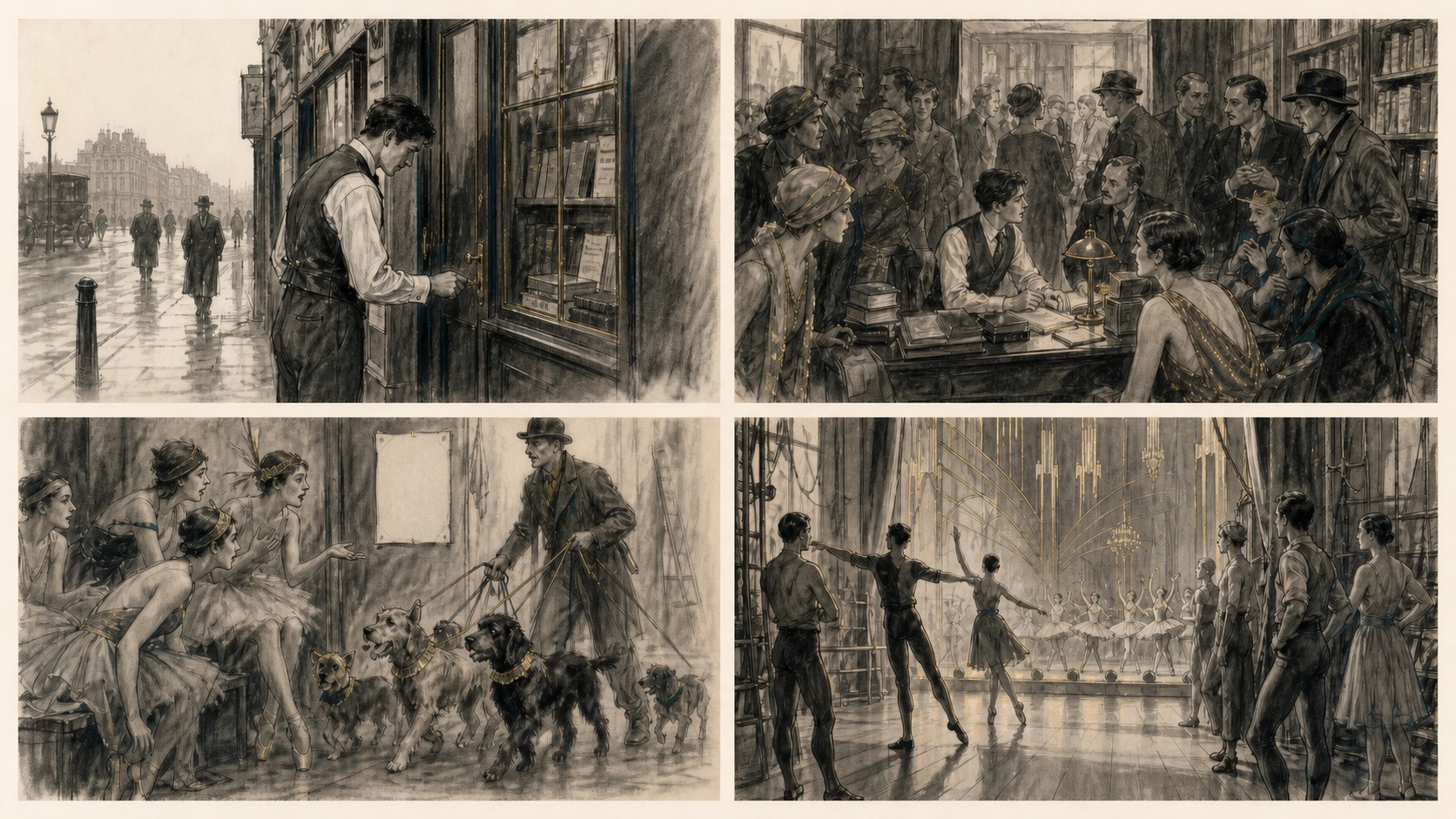
A young bookseller unlocks a tiny shop on Charing Cross Road. Before long, dancers, critics, artists, aristocrats and dreamers begin to gather there.
Outside, Britain is wrestling with class, empire and modernity. Inside, these characters believe they can reinvent the nation through ballet. An imported curiosity is on its way to becoming a symbol of British refinement.
The proposition“I see this as a stylish, witty four-part scripted drama, with Cyril Beaumont’s bookshop at the centre of the story.”
The contest
At the centre
His Charing Cross Road bookshop becomes the unlikely crossroads of British ballet—and the room where competing futures collide.
chase spectacle
seek influence
compete to define a national style
bring traditions the establishment trusts more than its own English dancers
Around Beaumont, Ninette de Valois, Marie Rambert and Arnold Haskell form shifting alliances, with Diaghilev and Pavlova casting long shadows over their ambitions. Their struggle over who controls ballet—and what makes it British—drives the drama.
The human comedy
Eccentricity, vanity and nerve turn a cultural origin story into character-led television.
An impresario is outraged to find his dancers billed alongside performing dogs.
A tailored suit, a tense German frontier and Oscar Wilde recited from memory.
A leading dance writer describes a great ballerina as “ugly”, “slightly humpbacked” and “an anatomical curiosity”—to make a startling argument: that discipline could triumph over nature.
Dancers reinvent themselves with foreign names as fiercely as they perfect their technique.
On screen
The intimate, crowded warmth of Beaumont’s bookshop contrasts with glamorous stages, punishing rehearsal rooms and a London caught between Victorian restraint and modern reinvention.
Why now
At a moment when Britain is again asking who belongs and who defines national culture, this reveals that an emblem of British refinement was built by émigrés, pioneering women and unconventional outsiders.
Michelle’s perspective
“After nearly two decades as a professional dancer and two years investigating the ISTD archive, I believe it is time to bring these characters back into the spotlight.”
Michelle Buckley · Dancer and PhD researcher
Sleeping Beauties, Sleeping Empires
For the full treatment, scripts and a production conversation, get in touch.
Request the full pitch